Wednesday, July 3, 2019

Lesson taught vs. lesson learned

The last post, the one on spanking, ended with the contrast between the lesson that was intended (Mommy still loves you even if she spanks you) and the actual lesson taught (You don't get to be in charge of your own body; stand still and take it if adults in charge invade your space and touch you).

It made me think of other unintended lessons that I learned at that age.

Case in point: lying.

Let's say I spilled my milk or broke something but no one was around to see it. Of course I'd be upset. All kids are upset when they spill things or accidentally break things. Kids know when they've messed up and then have to face the music when the adults find out. So faced with a broken glass or spilled milk, what should I, pre-schooler me, do?

According to my mother, I should tell the truth. She was quite adamant about that. Always tell the truth. Lying was bad, bad, bad and must be punished out of a child. Lying was a huge concern of hers. She didn't want her children to be lying little sneaks, because lying about little things could lead to lying about big things, and that led to no end of trouble.

And I knew in my bones that lying was wrong and that we should be truthful. I had no end of favorite picture books and young readers with plots revolving around kids messing up and what happened to the kids who lied versus the kids who bravely told the truth.

But if I told the truth, this is what happened:


If I lied and got caught, or gave myself away, or even if I took back the lie, this is what happened:


And if I lied convincingly enough this is what happened:


Given those three outcomes, what did pre-schooler me choose? In those circumstances, what would you choose?

The lesson Mom thought she as teaching? Don't lie. The lesson actually learned? If you screwed up, the odds are better if you lie about it and lie really well. And boy howdy, did I learn to cover up, sneak around, and lie like a pro.

I didn't want to be a liar. I would have liked to have been honest all the time. I would have liked it very much if my life had been like it was in the picture books: parents frown and briefly scold, then teach the child how to clean up the mess and how to be more careful next time, and the child is proud of learning how to do it right. Behind my lying poker face, my little heart was pounding like a third floor radiator when the steam heat turns on. I knew this was not how things were supposed to be.

But when I was punished equally for getting caught in a lie or telling the truth, I felt the injustice keenly. And, I admit, there was measure of contempt and a whole truckload of "what's the point of even trying?" behind my well-practiced lying.

That's been a hard lesson to un-learn. Well into adulthood I'm still surprised when I screw something up and admit it, and people I admit it to say, "Oh, that's okay. We can fix that." Because that would never have happened when I was a kid. Screwing up was never okay. And there was no fixing mistakes. All mess-ups were interpreted as naughtiness, carelessness, laziness, immaturity -- all things that needed to be punished hard.

And that, at long last, is my truth.

Monday, July 1, 2019

Spanking leaves indelible marks

The American Association of Pediatrics recently came out with a statement on spanking, which can be succinctly summarized as:


I think my favorite comment on this article when it showed up on Le Book Du Face was from a counselor who works with perpetrators of domestic violence who say, without a trace of irony, "I was smacked around a lot when I was a kid and I turned out okay."

Oh, you did, did you? Well. That's an interesting thing to believe.

Yes, I know a case can be made that, in extremis, it's better for a toddler who is about to run out into the street to feel the pain of a swat than the pain of being hit by a car. But spanking, swatting, paddling, or otherwise striking small children gets handed out all too often as the default reaction when a parent is angry. And that can turn dangerous in the blink of an eye.

I think people know this already, deep inside. You know that when people tack on "but I turned out okay" to stories of being spanked, they're already implicitly admitting that spanking can and does cause harm. But we've got a cult of parenthood that says we can't critique our parenting because everyone around us says, "But she's your mooootheeeerrr!" and... you know the rest. So we learn to pretend that it was with our best interests in mind that we were hit, or that it didn't really hurt, or hoo boy it did really hurt and wasn't that just hilarious?

No. It's not.

I was a shy child. I was sensitive in the emotional way that adults mean when they say with annoyance, "Stop being so sensitive!" as well as, I believe, some sensory sensitivities. I didn't need to be hit. I didn't need to be yelled at. A disappointed look, a frown, a raised voice all hurt and could stop me in my tracks, unless I was super over-tired and slap-happy as preschoolers can sometimes be. I was a smart kid. Explaining things to me was effective. Praise worked wonders. But I did get hit and I did get yelled at and I did live with mockery and criticism far, far more than I ever got praised.

My mother, having been raised on such old-fashioned methods herself, often spanked with a wooden spoon or a hairbrush or other such implement that came to hand. Not just one swat but multiple strikes on the backside. She had, I believe, the notion that if children weren't firmly disciplined and controlled then they would, without fail, run wild. Children must obey was her key phrase, because children who did not obey immediately would grow to break their mothers' hearts and end up in prison or on drugs or something. I also believe that when I was a small child there were... things... going on. I remember hearing raised voices and frequent arguments. There was tension in the household. Later we would move -- a lot -- as my dad searched for jobs that paid better and better. My mother, who had neuroses of her own, was probably feeling parts of her life were out of control, and compensated by trying hard to control the household. Including her children.

But I was just a small person who didn't understand. When you're small and the adults in charge of you are large and not entirely in control of themselves, and when they lose control when they're angry, it's terrifying. On one memorable occasion when I was a preschooler, my mother was spanking me repeatedly and angrily with a hairbrush so hard that the handle cracked and broke. I remember clear as day that she looked horrified at the broken implement, then shouted:


That's the sort of spanking that leaves a permanent mark on the soul. She often said later that after that incident she never struck me again with anything but an open hand.

Did that assuage the pain that hung heavy over my heart like black tumor? No, it did not. Hitting is hitting.

Now Mom, to her credit, had an idea that she'd gleaned from some book of parenting or magazine article or something about spanking. According to some expert, when one disciplines a child, one should also hug the child to reassure the child that they're loved and that all is well.

It's a pleasant and innocent sort of notion, and I'm sure my mother pictured it going like this:


However, what sounds like it ought to work in theory turns out to be naive and overly-optimistic in practice. And this, from the pre-schooler's point of view, is what it felt like in practice, and why by the time I was six I didn't like it when my mother touched me -- at all:


Did I just hear a collective gasp from the audience? I think I did. Because you all get this, right? You all get what I as a child was being taught? Large Angry Adult hits Small Upset Child until they cry and want to run away -- and then Large Angry Adult forces a hug on the Small Upset Child, threatening punishment if they don't submit, if they don't do it "right."

Large Angry Adult, with reinforcement from some child-rearing expert that I'd like to hit very hard at this moment, is teaching the Small Upset Child that they're not allowed to say no to forced physical contact.

I... don't even want to think right now about how that played out in my so-called marriage #1. Because... yeah... when being punished for saying "no" is the norm... well, that was the soul-crushing pit that I call so-called marriage #1. The part that most people never heard about, certainly not from him.

And that is what I mean when I say that spanking leaves indelible marks. On the soul. You don't forget these lessons. They try to replay themselves, so deeply burned they are into the subconscious. It takes a lot of practice and conscious thought to live by better rules, while the old rules still live like venomous snakes in the back of the mind, hissing, "Be nice and don't say 'no' or you'll be soooorrryyy..."

Thursday, June 27, 2019

Why bother? Because I'm on fire.

I hear it from some folks: why bother? Why dredge up the past? Why even talk about something that happened way back when you were four? What does it matter now? Grow up. Get over it. Forget about it.

Standard advice, pretty much. What most folks might call good advice. But... recent scientific studies say no. Why? Here's a short visual summary of research results:


See, you can tell the conscious mind to forget about it and get on with things. But the body remembers. Or as a popular book title says, The Body Keeps The Score (Amazon.com link).

The link between trauma and chronic inflammation has increasingly strong support in physiological and neuroscience research. So what are we talking about here? Why does it matter?

Because while acute inflammation is a normal response to injury, chronic inflammation is at the heart of most chronic diseases and disorders:
  • Vascular disease begins with inflammatory damage in the arteries.
  • Migraine is currently thought to involve (among other things) inflammation of the trigeminal nerve and surrounding blood vessels.
  • Inflammatory Bowel Disease is pretty obviously related to chronic inflammation.
  • Autoimmune diseases (and the list now includes Type II diabetes) may begin with chronic inflammation.
  • Damage from chronic inflammation contributes to some cancers.
  • Depression is now thought to be related to inflammation in parts of the brain.

Now, that doesn't mean that everyone who has an inflammatory-related disorder also had childhood trauma. And childhood trauma doesn't guarantee developing an inflammatory-related disorder. What we're talking about here is risk factors: trauma in childhood increases the risk of chronic inflammation which increases the risk of developing a chronic illness.

Okay, so what counts as trauma? Here's where it's useful to just sit back and listen, because when it comes to childhood trauma, there are no contests. I know, you start telling your childhood story of being raised in a dysfunctional family, and someone will bellow over you, "Hah! That's not trauma! That's just normal growing up! Trauma is what soldiers in combat experience, or kids in a war zone, stuff like that!"

Oh, that is so not helpful. Never, never, never think that one person's experience doesn't count as trauma just because another person had it much worse. Because the truth is, whatever the body and subconscious themselves count as trauma can result in trauma-related inflammation! See, thing is, you can't just reason away what the subconscious perceives. You can't scold it into submission. You can't shame it into thinking, "Gee, other people have it worse than I did, I guess everything is hunky-dory then."

I can't say it enough: If your body and subconscious say it's trauma, then it counts as trauma and can have consequences to your health.

That's why increasingly the standard advice for managing chronic inflammatory-related disorders includes managing stress and emotions through counseling, mindfulness activities like meditation or yoga, and exploring the past to uncover the links and make sense of them. It's emotional labor that can actually help.

But don't just take my word for it. I'm not a physiologist or neuroscientist. My scientific training started out in botany, and later moved on to adult learning and cognition. What I know about this is from my own literature searches for answers about my migraines and chronic fatigue (I don't have official Chronic Fatigue Syndrome, but I do have something). And if you wandered in here because you're searching for information for that term paper, for pity's sake don't use this blog post in your "resources" list! Your teacher/instructor/professor will probably knock points off for not using valid sources. Try this list of articles and primary sources instead:


The list goes on and on. When you read these articles, you'll see that what researchers count as trauma isn't all about war zones and natural disasters and such. It can be everything from egregious physical or sexual abuse to emotional neglect. What the child experiences as traumatic, the body counts as traumatic. When the child feels like the world is dangerous, the brain becomes wired to respond to every little possible threat.

Exposure to different traumas leaves its mark in the form of different inflammation-related biomarkers. And that is something that can't be waved off by the scoffers.


Saturday, June 22, 2019

Roller Skates and Bagpipes

For all the things about me that my mother did not tolerate, it's surprising the kinds of things she did put up with.

Case in point: Me, roller skating, when I was four or five.

Sure, lots of kids roller skate. But not the way I did it.

I had a pair of skates, the old kind that fastened on to your shoes and tightened with a skate key. I could just about do that myself, though I often needed help.

The part I always needed help with, though, was putting on the record of Scottish bagpipe music. Mom had to put that on the hi-fi stereo for me, because it was Dad's 33 1/2 rpm record and he wouldn't like it if I scratched it.

Why bagpipes? I have no recollection of how that started. Dad's family has roots in the lowlands of Scotland, which is why he had the record in the first place. A little Scots pride. A little ancestral memory, maybe. In my imaginative hindsight, maybe my Border Reiver ancestors were singing in my blood, urging me to mount a sturdy steed and ride out to terrorize the English or whoever was the Reiver target of the moment.

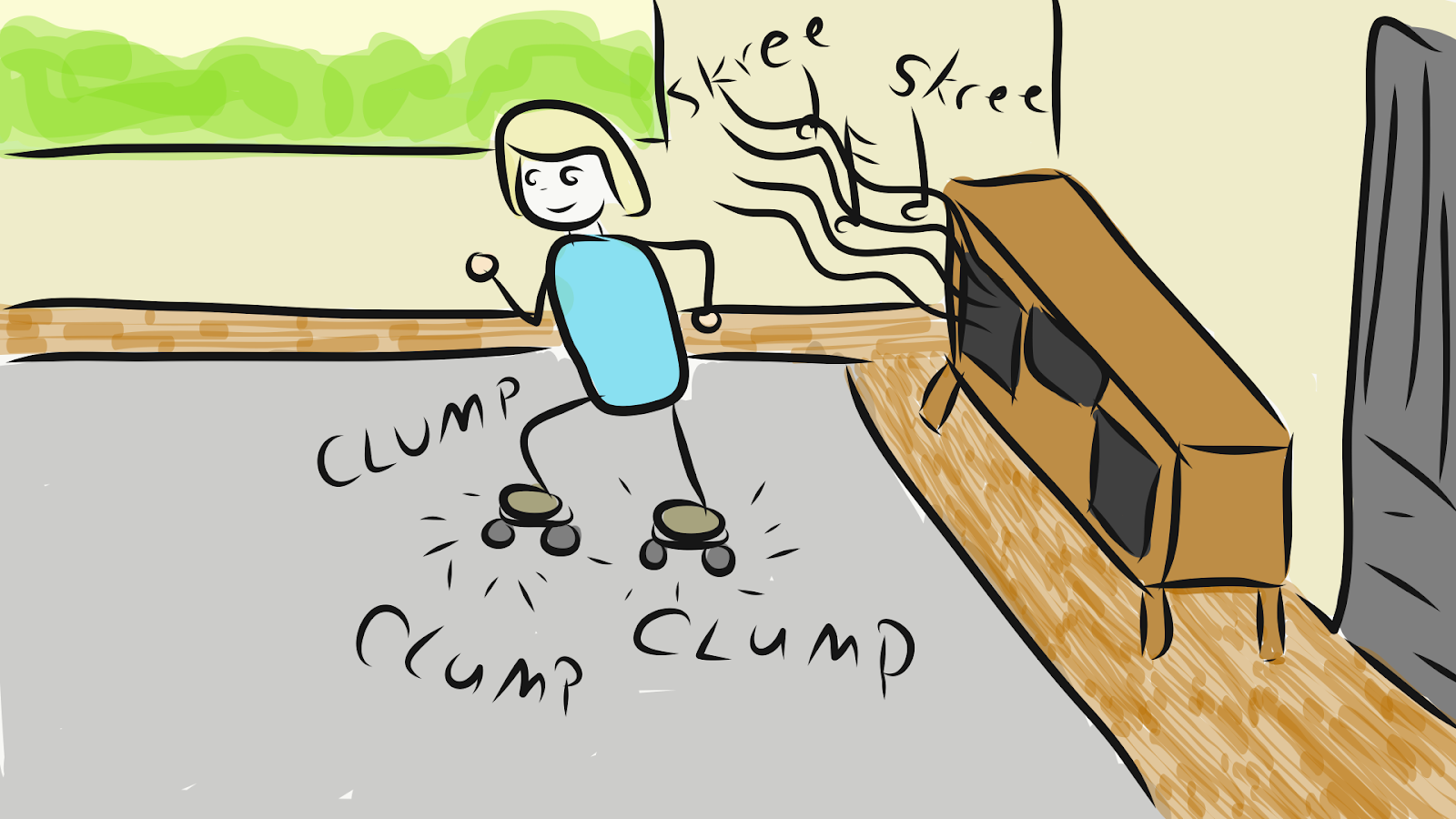
Once Scotland the Brave was rolling out of the speakers, away I'd go, around and around on the gray wool carpet that overlay the wooden floor of the living room. CLUMP CLUMP CLUMP around and around and around because at four or five I didn't know how to actually make the roller skates roll much. CLUMP CLUMP CLUMP while the bagpipes went skree skree skree-skree-skree skree skree SKREE SKREE SKREE-SKREE-SKREE skree skree, around and around... around and around... CLUMP CLUMP CLUMP SKREE SKREE SKREE CLUMP CLUMP CLUMP SKREE SKREE SKREE...


... until eventually Mom couldn't stand it any more and came it to say I'd have enough and wouldn't I like to play with my toy dishes now?

"No." The horses were still galloping across the heath, the pipes still singing away, and I was still riding among them.

CLUMP CLUMP CLUMP

SKREE SKREE SKREE-SKREE-SKREE SKREE SKREE


"It's getting to be nap time now," Mom would say.

Nap? Scottish warriors don't take naps. I had places to go, enemies to fight. "Not yet."

CLUMP CLUMP CLUMP

SKREE SKREE SKREEEEE SKREEEEE SKREE-SKREE-SKREE


"ALLLL RIIIGHT" Mom would say, and she'd take the needle off the record.

CLUMP CLUMP CLUMP clunk clatter as Mom finally caught up with the pint-sized Border Reiver and lifted her bodily off of her metallic steeds.

And that was it. Off came the record, off came the skates -- there might have been some kicking and protesting involved and possibly shoes removed skates and all -- and off I was transported into my crib.

Well. You can put a Reiver in prison.


But you can't make her nap.

Tuesday, June 18, 2019

It all started in a house on a hill.

When I was born we lived in a pale yellow house on Hillview Street, which was actually on a hill and actually had a view (not like how they sometimes name an apartment complex "Pine Mountain" and it's on the flats without a tree in sight), in 1960s suburbia. I was the third of three kids, with two brothers before me. When I was born, Dad reportedly said, "Oh, boy, it's a girl!" My mother was thrilled. She finally had her little dream girl, her little shadow, someone she could do all the mother-daughter things she'd dreamed of with. In a house full of males, there was finally someone to be on her side of the gendered divide.


My brothers were, I think, less than thrilled. My oldest brother M, was six when I was born. My middle brother, K, was three. We lived in a three bedroom house. My parents figured with parental obviousness that one bedroom would be for "the boys," and one for "the girl." And that, of course, began the story my brothers started spinning about how "spoiled" I was and how I always got my way and got all the good things. I was only a baby and I got my own room. The boys got a new set of bunk beds and now had to share a room. Later, when we moved into another 3-bedroom, I remember M complaining, "How come SHE always gets her own room and we don't?" His idea was that he, as the eldest, should be the one to have a room to himself. "Which of you is going to share a room with your sister?" Dad asked. My brothers just glared, and I thought, well, where would I have to sleep?

On the couch?


Move my crib to the garage?


I could picture it all so clearly, and was, for a moment, afraid it might actually happen. I think my brothers would have been fine with any of those so long as they got their own way.

Mom says I was an "easy" baby. I don't know how easy I was as far as babies generally go, or if by the third child she just kind of knew what to expect.

It was all great except the hair.

Of which I had practically none.


I was a bald baby. My mother was extremely embarrassed at having a bald baby girl. I guess I was supposed to be born with a full head of golden ringlets or something. All I had was transparent peach fuzz, so I didn't look girly enough so people felt compelled to ask, "Is it a boy or a girl?" Which was not okay with Mom. No one should be mistaking HER little GIRL for a BOY! Nope. She had a GIRL at last, and there must be no confusion.


Every time we left the house, she tells me, she'd put a baby bonnet on me. To hide my bald head that embarrassed her so much. And to make me demonstrably a frilly little girl so people wouldn't have to ask.

Yep, already. Right out of the box, I was "product not as expected."

Okay, sure. A baby bonnet is not big deal. As a baby I couldn't possibly know any difference. What did I know? Probably all I could make out was manically smiling faces and enthusiastic voices going, "Wah WAH wah WAH WAH waaaahh," like the adults in the Charlie Brown movies. I don't even know if I protested about having a thing tied on my head or if I tried to pull it off as babies so often do.


If Mom thought sticking a bonnet on my little bald head was all it took to make me into her dream baby, she was about to learn it wasn't going to be that simple. I wasn't that simple.

Also, it was the earliest taste of how much of my mother's self-esteem at the time was wrapped up in being a perfect mother to a perfect family, and how much I was to carry the weight of my mother's feelings every time I failed at being her perfect dainty delicate little dream girl.

Monday, June 17, 2019

In the beginning: first post

I know that title is pretty obvious. But you have to start somewhere, right?

Like most personal blogs, this is a blog about my life. It's not about pictures of my dinner or vacation bragging and stuff. It's about coming to grips with all that happened, making peace with the past and with myself, and figuring out what life was trying to teach me.

On the surface, my childhood was pretty normal: middle-class family, three kids, a dog, some cats, two parents who stayed married.

Under the surface there was stuff happening. Moving too many times. Parental fights. Pathological sibling stuff. High, very high, way too high expectations.

And always, underneath it all, the ongoing message that I wasn't quite what my family had ordered. And so the title of this blog.

See, I was supposed to be The Girl TM. All pink and pretty. Button nose and saddle shoes. Sugar and spice and everything nice. Cute and sweet. Ruffles and curls. Mommy's mini-me.

What I turned out to be was noisy, messy, and anxious. I liked blue and disliked pink. I had sensory issues. I was emotionally needy. I woke up at night vibrating with anxiety. None of that was okay with anyone else in the house.

What's more, I wasn't even that keen on being a girl. Dolls seemed pointless, but trucks out in the sandbox and piles of stuffed animals were great. I wanted a chemistry set. I was given a tea set. And hoo, boy, none of that was okay with my mother.

The message came through in oh, so many ways: I was not the little dream girl she wished for and, after producing two boys, felt entitled to have. And that was never, never okay.

For readers who need trigger warnings, I promise there won't be too many big traumas, just lots of little ones. And what do I hope to achieve with this? Mostly, on a personal level, to understand what happened and how it shaped me. But if there's anyone else out there who feels a little bit validated, who thinks, "Yeah, that happened to me, and everyone acted like it was normal but now I get that it's not and that my feelings were real and I get to feel them," then yay, something good has come out of this.

Also, this is my blog and I get to set the rules about comments. Spam and hate will be deleted and the authors blocked without comment or warning. Yes, everyone has freedom of expression. Just not on my blog. Anyone can have their own blog and say what they want.

Hand-Me-Downs

One consequence of having parents who grew up in the Great Depression, who ran a household where income was only modest, was wearing hand-me...